
.png)
Why Occult Symbols Become Jewelry
Why Occult Symbols Become Jewelry
For thousands of years, people have worn symbols.
Long before jewelry became primarily decorative, it carried meaning. Amulets were worn for protection. Religious symbols expressed faith. Talismans represented luck, power, devotion, identity, or a connection to something beyond the physical world.
Occult jewelry continues that tradition.
A pentagram, Sigil of Baphomet, Seal of Lucifer, Brimstone Cross, or other esoteric symbol worn around someone's neck isn't necessarily there simply because it looks interesting. For many people, the symbol says something about who they are, what they believe, what they question, or the path they have chosen for themselves.
Jewelry Has Always Been More Than Decoration
Humans have been turning meaningful objects into things they can wear for thousands of years.
Ancient cultures wore amulets intended to protect the wearer from misfortune. Religious communities developed medals, pendants, rings, and other objects representing devotion. Symbols associated with the sun, moon, animals, gods, death, fertility, protection, and the supernatural appeared repeatedly across cultures.
The materials and beliefs changed.
The idea didn't.
Wearing a symbol physically places something meaningful close to you.
That is one reason jewelry remains such a natural home for occult symbolism.
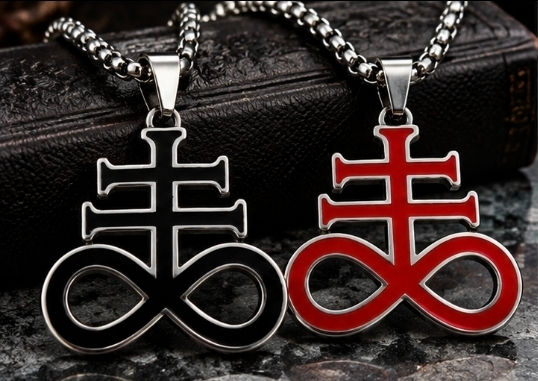
A Symbol Can Become a Statement of Identity
Not everyone who wears occult jewelry interprets a symbol in exactly the same way.
For one person, an inverted pentagram may represent Satanism.
For another, it may represent rebellion against conventional religious authority.
Someone else may simply have a lifelong fascination with occult history, ritual, horror, gothic culture, or esoteric philosophy.
The same can be said for symbols associated with Lucifer, Lilith, Baphomet, alchemy, witchcraft, pagan traditions, and countless other paths.
Symbols acquire meaning through both their history and the people who choose to carry them.
That makes jewelry unusually personal.
A shirt eventually goes into a drawer.
A poster stays on a wall.
But a pendant can become something a person wears almost every day.
From Hidden Symbols to Visible Ones
There is also an interesting contradiction within occult symbolism.
Historically, esoteric knowledge was often concealed.
Symbols appeared in grimoires, manuscripts, magical diagrams, alchemical texts, secret societies, religious traditions, and philosophical works that most people would never encounter.
Today, many of those symbols are worn openly.
Something once hidden inside the pages of an obscure book can now hang from someone's neck.
That transformation says something about modern alternative culture.
People increasingly choose to make visible the things that previous generations might have been expected to hide.
The Power of the Uncomfortable Symbol
Some symbols attract people precisely because they make others uncomfortable.
The goat.
The inverted pentagram.
The number 666.
The Sigil of Lucifer.
The Brimstone Cross.
These images challenge conventional expectations about what people are supposed to display publicly.
For some wearers, that is part of their appeal.
The jewelry becomes a rejection of conformity.
It can say:
I decide what has meaning to me.
I decide what I believe.
I decide which symbols I wear.
That doesn't require the wearer to explain themselves to everyone who sees it.
Sometimes the symbol itself is enough.

Occult Jewelry Can Also Be a Conversation
Symbols invite questions.
Someone sees an unfamiliar pendant and asks what it means.
That question can lead to mythology, religion, history, philosophy, Satanism, witchcraft, paganism, folklore, alchemy, literature, or simply someone's personal story.
This is one of the things that separates symbolic jewelry from purely decorative jewelry.
There can be an entire history contained within a piece only an inch across.
The Meaning Belongs to the Wearer
There is another side to all of this that we believe is important.
We can explain where a symbol originated.
We can discuss its historical use.
We can tell you what occultists, religions, authors, artists, or organizations have said it represents.
But we cannot decide what it means to you.
Symbols evolve.
They are adopted, rejected, rediscovered, reinterpreted, and sometimes transformed completely by later generations.
That's part of what makes them fascinating.
You don't necessarily have to belong to an organization or follow a particular doctrine to find meaning in an ancient symbol.
Your reasons for wearing it can be entirely your own.

Why Sigil Occult Jewelry Exists
This idea has been part of Sigil Occult Jewelry from the beginning.
We don't see these designs as random graphics placed on jewelry because they happen to look dark.
The symbols came first.
The jewelry became a way to carry them.
Since 2013, we've created pieces influenced by occultism, Satanism, gothic culture, punk, mythology, rebellion, and the darker corners of history and symbolism.
Some customers wear our jewelry because of deeply held beliefs.
Others wear it because a particular symbol represents independence, individuality, rebellion, or something personal that may never be obvious to anyone else.
And some simply love the darker aesthetic.
All of those reasons are valid.
Because ultimately, jewelry becomes meaningful when the person wearing it gives it meaning.
Wear the Symbol. Live the Message.
Occult symbols have survived for generations because people continue to find something within them worth carrying forward.
Books preserved them.
Artists reinterpreted them.
Subcultures adopted them.
And people began wearing them.
That's where jewelry becomes more than an accessory.

It becomes personal.
It becomes identity.
It becomes a statement.
Wear the Symbol. Live the Message.


Comments